Photography
Shooting my first paid accommodation job
The gear, the order I work through rooms, the trick for tiny bathrooms — and the one thing I still haven't worked out.
Where I'm at: one paid job done. I'm not a working professional with a decade behind me — I'm at the start of this, and writing it down as I go. Take it as one person's method, not gospel.
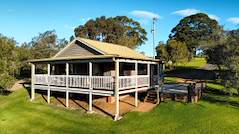
Late afternoon light doing most of the work for me
I love photography. That's the whole origin of this — not a business plan, just a thing I've always enjoyed doing and eventually realised people would pay for.
I've now done one paid accommodation shoot. One. So this isn't a masterclass; it's the beginning of a working method, written down while it's still forming.
Why this, of all things
It fits the rest of my life in a way most side work doesn't.
You get to see places you'd never otherwise walk into. It's genuinely creative rather than admin. And it stacks neatly with travel — the same trip that's a holiday can also be work, which matters when you're trying to fund something as expensive as an extended stay in Europe.
I want to do more of it across New South Wales, and eventually further afield.
What I actually use
Less than people assume.
- Canon M50 with the kit lens. My favourite by a distance — the files are better, the control is better. The only downside is bulk. It's not something I carry everywhere.
- Google Pixel 9 Pro XL. Genuinely excellent, and it earns its place properly in tight spaces. More on that below.
- Insta360 One X2. Useful for 360 and for anything where I want movement or an unusual angle.
The honest observation from one job: the phone did more work than I expected, and the camera did the work that mattered most. Both earn their place.
The kit
Everything I shoot accommodation with
Canon M50 with the kit lens, a Pixel 9 Pro XL that does more work than it should, and an Insta360 One X2 for the awkward angles. I keep the current list, with the bits and pieces that go with them, over on Benable.
See the full kit →Some links on that page may earn me a small commission at no extra cost to you. I only list things I actually own and use, and nothing is there because someone paid for it.
The order I shoot in
Having a fixed sequence stops you standing in a hallway wondering what you've missed. Mine goes:
- Bedrooms first. They're usually the most carefully styled, and they're least likely to get disturbed while you're working elsewhere. Get them while they're perfect.
- Kitchen. Often the room that sells a place — people picture themselves making coffee in it.
- Amenities and bathrooms. The tightest spaces, and the ones that need the most problem-solving.
- Outdoor spaces. Decks, pools, balconies. In Australia these frequently do more selling than any interior.
- The surroundings. The street, the view, the walk to the beach. This is the context that makes a listing feel like a location rather than a floor plan.
Working in that order also means you're outside later in the day, which usually suits the light.
Small rooms, and the phone trick
This is the practical thing I'd most want to pass on.
Tiny bathrooms and small bedrooms are where a proper camera struggles — you physically cannot get far enough back. My solution is the phone's ultra-wide, at 0.5x, held high and angled slightly down.
High angle, ultra-wide, slightly down. Tiny rooms suddenly have space in them.
The height does something specific: it shows more floor, and floor reads as room. Shoot a small bathroom at chest height and it looks like a cupboard. Shoot it from above eye level and it breathes.
What most listings get wrong
Having gone looking at a lot of Airbnb listings with a critical eye, a few things come up repeatedly.
The angles
Most bad listing photos aren't badly exposed — they're badly positioned. Shot from standing height, straight on, from the doorway. Corners of rooms, taken from a corner, are usually more generous than a flat wall shot from the middle.
Over-editing, or no editing at all
Both extremes hurt. Raw, untouched photos look flat and slightly grim. Heavily processed ones look like a different property to the one guests arrive at, which is worse — it sets up disappointment.
A light touch is the answer: correct the colour, lift the shadows a little, straighten the verticals. Make it look like the room on a good day, not like a render.
Time of day, and time of year
This makes more difference than anything else, and it's free.
Harsh midday sun blows out windows and throws hard shadows across the floor — especially here. Early morning and late afternoon light is softer and warmer, and makes interiors glow rather than glare.
Season matters too. The same garden in February and July is effectively two different properties.
Empty rooms
A perfectly tidy, entirely empty room looks like a real estate listing. A table set for two, a throw slightly rumpled, a book on the arm of a chair — those small signs of life make it look like somewhere you'd stay rather than somewhere you'd inspect.
You don't need people in the frame. You need evidence that people exist.
The bit I haven't solved
Pricing. Honestly, this is the part I find hardest, and I suspect I'm not alone.
Charge too little and you undercut both yourself and everyone else doing this properly. Charge too much with one job behind you and you don't get the work.
Here's my actual number, because this is exactly the figure I wanted someone else to publish before my first job and couldn't find anywhere.
| My first paid job | |
|---|---|
| Fee | $350 |
| Edited images delivered | 20+ |
At the time I had genuinely no idea whether that was reasonable. I picked a number that felt defensible and hoped.
So I went and looked at what the market actually does in Australia:
| Type | Typical range |
|---|---|
| Professional property session | $200–500 |
| Rental / Airbnb package (around 10 images) | from ~$199 |
| Hourly rate | $200–500 |
| Full day rate | $1,200–3,000 |
Having seen that, $350 for 20-plus edited images sits comfortably in the normal band — generous on image count, if anything. Which was a relief, and also slightly annoying, because I'd spent a week worrying about it.
Which is useful context, and still doesn't tell me where I sit. Rates vary enormously by region — regional and small-town work generally goes for less than capital city work — and by what's included: number of images, editing, turnaround, whether you're licensing the photos or handing them over outright.
The thing I keep reminding myself is that the property owner isn't buying photos, they're buying bookings. Better photos demonstrably drive more of them, and at a higher nightly rate. On a place charging a few hundred a night, a good shoot pays for itself almost immediately.
Knowing that intellectually and saying a number out loud on a call are, it turns out, two very different skills.
I'll write about it again once I've done a few more and actually know.
Questions I get asked
What order should you photograph a property in?
Bedrooms, kitchen, amenities and bathrooms, outdoor spaces, then the surroundings. Bedrooms first because they're usually the most styled and least likely to be disturbed.
How do you photograph a really small room?
Phone ultra-wide at 0.5x, held above eye level, angled slightly down. Showing more floor makes the space read as larger.
What time of day is best?
Early morning or late afternoon. Midday sun blows out windows and creates hard shadows.
How much does accommodation photography cost in Australia?
Typically $200–500 a session, with rental packages from around $199 and day rates between roughly $1,200 and $3,000.
Shoot properties yourself? I'd love to know how you landed on your pricing.